
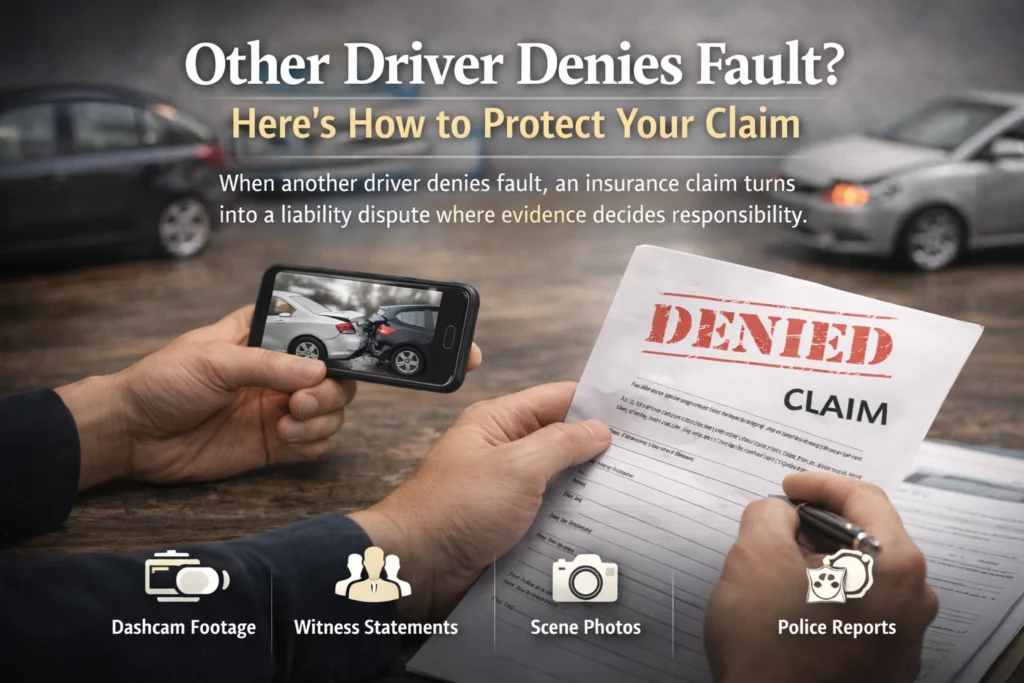
When another driver denies fault, an insurance claim turns into a liability dispute where evidence decides responsibility. A denial does not block repairs or compensation by itself. A denial triggers an investigation that uses dashcam footage, witness statements, scene photos, vehicle damage patterns, and police reports to reach a fault decision.
Contents
- What “denied fault” really means
- What to do in the first 24 hours
- What evidence wins most often (evidence hierarchy)
- How to write an incident statement that holds up
- How liability decisions are typically made
- What not to do when fault is disputed
- How do I request CCTV?
- What if there are no witnesses?
- How long can denial disputes take?
What “denied fault” really means
A “denied fault” statement means the other driver rejects responsibility, so an insurer treats the crash as contested liability. A contested liability file stays open while an adjuster compares evidence, statements, and road rules. A denial often changes the timeline and proof burden, not the core right to make a claim.
Rules
Common reasons a driver denies fault include:
- A driver protects an insurance re
Rules
driver disputes a lane position, right-of-way, or signal phase. - A driver challenges injury or damage scope after the crash.
What to do in the first 24 hours
The first 24 hours set the evidence baseline for an insurance investigation. You protect a claim by preserving objective records, creating a time-stamped photo set, and locking a clean narrative. A strong first day file includes contact details, vehicle identifiers, and medical notes when symptoms appear after impact.
Rules
Complete the first-day actions in a fixed order:
- Report the crash to an insurer and record the claim reference number.
- Collect identifiers: driver name, phone, registration, insurer, and policy details when available.
- Document the scene with wide-angle photos, close-ups, and r
Rules
digital evidence**: dashcam files, phone videos, and metadata-backed timestamps. - Seek medical documentation when pain, dizziness, or restricted motion starts after the crash.
What evidence wins most often (evidence hierarchy)
Liability decisions prioritise evidence that shows objective sequence and road positioning. Video evidence often carries the highest clarity because video frames show speed, signals, and collision timing. Witness statements strengthen credibility when witness statements match scene photos and vehicle damage direction. A complete evidence pack reduces dispute time and increases settlement probability.
Evidence hierarchy that insurers commonly value (strongest to weakest):
- Dashcam footage / traffic camera video with a clear view of the manoeuvre.
- Independent witness statement with contact details and observation position.
- Scene photos showing signage, lane markings, debris field, and final rest positions.
- CCTV footage requests from businesses, councils, or car parks, made fast before overwrite cycles.
- Police report / incident number and any issued citations when police attend.
How to write an incident statement that holds up
An incident statement works best when an incident statement reads like a timeline that matches photos and vehicle damage. You improve credibility by using location, time, travel direction, lane position, traffic signals, speed range, and point of impact. A consistent incident narrative reduces contradictions that insurers flag during a liability investigation.
Rules
Include the following fields in an incident statement:
- Date, time, and exact location (road name, junction name, or landmark)
- Travel direction and lane position for each vehicle
- Traffic controls (signals, stop lines, give-way markings, roundabout entry)
- Manoeuvre description (turn, merge, lane change, braking event)
- Point of impact (front-left, rear-right) and immediate aftermath (final positions)
- Names and numbers for witnesses and attending officers (when present)
How liability decisions are typically made
An insurer makes a liability decision by comparing evidence against road rules and consistency across statements. An adjuster checks collision mechanics, damage patterns, and timeline alignment across dashcam files, photos, and independent witness accounts. When evidence stays balanced, insurers sometimes agree split liability, which divides cost responsibility by a percentage.
A typical liability workflow follows this sequence:
- Evidence collection and verification (authenticity and timestamps)
- Driver statement review for contradictions and omissions
- Scene reconstruction using photos, damage, and
Rules
een insurers when both insurers dispute liability - Settlement, partial settlement (contributory negligence), or escalation (formal dispute route)
What not to do when fault is disputed
A fault dispute stays easier to resolve when communication stays factual and consistent. Social media posts create discoverable statements that insurers review during a claim. Angry messages and admissions create avoidable contradictions that insurers interpret as credibility signals. A clean communication record supports a straightforward liability assessment.
Rules
Avoid the following actions during a denial dispute:
- Publish crash details, photos, or injury updates on social platforms
- Send insults, threats, or repeated messages to the other driver
- Admit fault in texts or calls when evidence review stays incomplete
- Edit or “trim” dashcam footage before sharing with an insurer (preserve the original file)
Can I still get repairs and a replacement car?
You can still arrange repairs and a replacement vehicle while liability stays disputed, because many policies offer repair routes and courtesy car options through approved networks. Non-fault routes sometimes use credit hire where a hire provider recovers costs from an at-fault insurer after liability resolves. Replacement vehicle paperwork stays strongest when you keep repair estimates and daily-need notes.
How do I request CCTV?
A CCTV request works best when you act fast, identify the camera owner, and submit a subject access request (SAR) when footage contains personal data. UK organisations respond to SARs within one month, with limited extensions for complex requests. You strengthen a CCTV request by providing time window, location, and identifying details that narrow the search scope.
Use a precise CCTV request format:
- Exact date + start time + end time (example: 14:10–14:25)
- Exact location (entrance name, junction name, storefront name)
- Identifiers (vehicle
Rules
ction of travel) - Request purpose: “insurance claim evidence for road traffic collision”
- Request type: “preservation request” + “copy request” (when allowed)
What if there are no witnesses?
A no-witness crash still supports a strong claim when physical evidence stays consistent and well-documented. Photos of lane markings, debris patterns, and damage direction help reconstruct manoeuvres. Dashcam video from third parties sometimes exists, so you can ask nearby drivers, local community groups, or businesses for camera coverage in the same time window.
How long can denial disputes take?
A denial dispute timeline depends on evidence availability, insurer responsiveness, and negotiation complexity. A dispute often resolves faster when video evidence exists and both insurers share documentation early. A dispute takes longer when CCTV retrieval delays evidence review or when both sides claim equal priority at a junction or roundabout.