
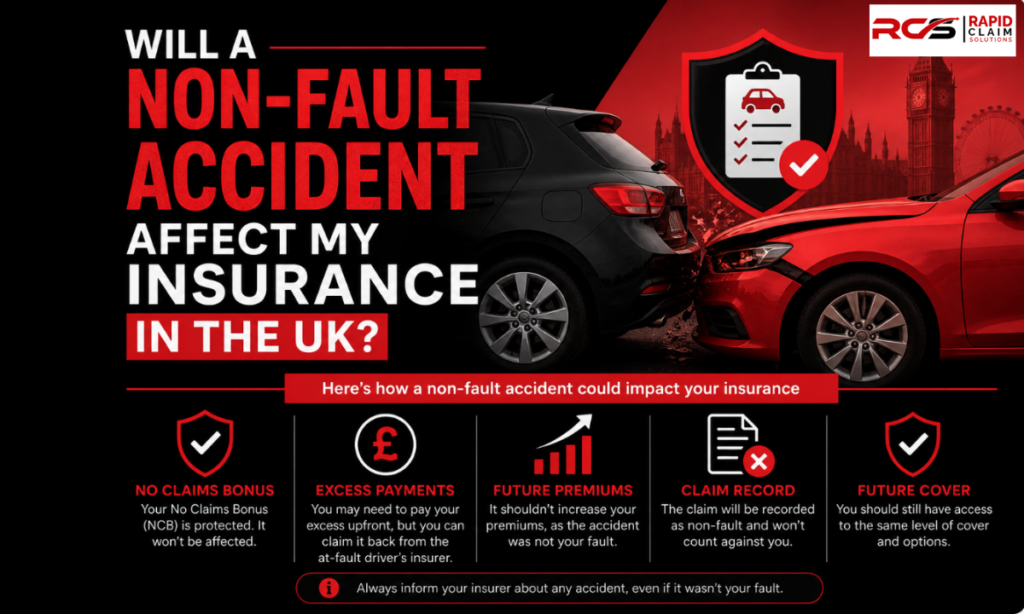
Will a non-fault accident affect my insurance in the UK? In many cases, the answer is yes. Even if another driver caused the accident, your future insurance premium may still increase. This happens because insurers assess overall risk rather than fault alone when calculating premiums.
Many motorists find this frustrating because they expect their insurance to remain unchanged after a non-fault collision. However, non-fault accidents can still influence premiums, claims history, and future policy terms. Understanding how insurers assess risk can help you avoid unexpected surprises at renewal.
Contents
- How Non-Fault Accidents Influence Insurance Premiums
- Factors That Determine Premium Increases
- The Impact on Your No Claims Bonus
- Why Premiums Can Rise After a Non-Fault Accident
- Declaring Non-Fault Accidents to Your Insurer
- Understanding Excess Payments After a Non-Fault Claim
- Claims Involving Uninsured Drivers
- How Non-Fault Claims Usually Work
- Why You Should Avoid Admitting Fault
- Practical Support Following a Non-Fault Accident
- Protect Your Insurance Position After Any Accident
- Common Questions About Non-Fault Accident Insurance
How Non-Fault Accidents Influence Insurance Premiums
A non-fault accident can still affect your insurance premium because insurers use statistical models to assess future risk. Even when another driver was entirely responsible, insurers may consider previous incidents when calculating renewal prices. As a result, some motorists notice higher premiums despite being completely blameless.
According to independent non-fault accident advice from Citizens Advice, a genuine non-fault claim should not automatically reduce your No Claims Bonus if your insurer recovers all costs from the at-fault driver.
However, insurers often consider claims frequency and overall risk exposure when setting premiums, which explains why increases can still occur.
Factors That Determine Premium Increases
There is no fixed amount by which insurance premiums rise following a non-fault claim. The increase depends on several factors, including your insurer, driving history, postcode, and previous claims record. Some drivers experience only small increases, while others notice more substantial changes.
Factors that may influence premium changes include:
- Your insurer’s underwriting criteria.
- Your claims history.
- The value of the claim.
- Your postcode.
- Previous accidents or incidents.
- The number of claims declared.
Because insurers calculate risk differently, comparing multiple quotes at renewal remains one of the best ways to find competitive cover.
The Impact on Your No Claims Bonus
A genuine non-fault claim should not affect your No Claims Bonus if your insurer successfully recovers all associated costs from the at-fault driver’s insurer. However, your bonus may sometimes be temporarily reduced while liability investigations are ongoing. Once costs are recovered, insurers often restore the bonus.
The Association of British Insurers explains how No Claims Discount rules vary between providers and policy types.
Even if your No Claims Bonus remains unchanged, future premiums may still increase. Understanding this distinction helps motorists avoid common misconceptions.
Why Premiums Can Rise After a Non-Fault Accident
Insurance premiums can increase after a non-fault accident because insurers rely heavily on historical claims data. Research suggests that drivers involved in one incident may be statistically more likely to make another claim in the future, regardless of who caused the original accident.
Although many motorists disagree with this approach, it remains common practice across the insurance industry. For this reason, drivers should review renewal offers carefully rather than automatically accepting them.
Declaring Non-Fault Accidents to Your Insurer
Most UK insurers require motorists to declare non-fault accidents and claims. Failing to disclose a previous incident could breach policy conditions and create difficulties if you need to make a future claim. Many insurers also ask drivers to declare accidents from the previous five years.
Official guidance on reporting a car accident to your insurer recommends notifying insurers after any road traffic accident, even if you do not intend to claim.
If you are uncertain about the claims process, professional accident assistance services can help you manage the practical aspects of the incident while ensuring important information is not overlooked.
Understanding Excess Payments After a Non-Fault Claim
If you claim through your own comprehensive insurance policy, you may initially need to pay your policy excess to begin repairs. Your insurer will usually attempt to recover those costs from the at-fault driver’s insurer once liability has been established.
If recovery is successful, your excess is normally refunded. Recovery times vary depending on how quickly insurers agree liability and whether any disputes arise.
Motorists whose vehicles are unsafe to drive after an accident may also benefit from vehicle recovery and secure storage while claims investigations continue.
Claims Involving Uninsured Drivers
Claims involving uninsured or untraced drivers are often more complicated because insurers may struggle to recover costs. If recovery is unsuccessful, the incident could affect your No Claims Bonus unless your policy includes an uninsured driver promise.
Motorists involved in these situations may be able to seek compensation through the Motor Insurers’ Bureau compensation scheme.
Collecting evidence immediately after the accident becomes especially important when uninsured drivers are involved. Photographs, witness details, dashcam footage, and police reports can significantly strengthen your claim.
How Non-Fault Claims Usually Work
When another driver causes an accident, their insurer is generally responsible for covering eligible losses linked to the collision. Depending on the circumstances, recoverable costs may include vehicle repairs, replacement transport, recovery charges, and other reasonable expenses.
| Potential Costs | May Be Recoverable |
| Vehicle repairs | Yes |
| Replacement vehicle costs | Usually |
| Recovery and storage charges | Often |
| Policy excess | Usually |
| Personal injury losses | Potentially |
Drivers who need to remain mobile while repairs are carried out may qualify for replacement vehicle services, helping minimise disruption to daily life.
Why You Should Avoid Admitting Fault
You should avoid admitting fault immediately after an accident because the full circumstances may not yet be known. Liability decisions are normally based on evidence gathered after the collision, meaning early admissions could complicate the claims process unnecessarily.
Insurers typically consider:
- Witness statements.
- Dashcam footage.
- CCTV recordings.
- Vehicle damage patterns.
- Highway Code rules.
- Photographs from the scene.
Practical road traffic accident advice recommends gathering evidence and exchanging details rather than discussing liability at the roadside.
Practical Support Following a Non-Fault Accident
Managing repairs, recovery arrangements, replacement vehicles, and insurer communications can quickly become stressful after an accident. Seeking support early often reduces disruption and helps ensure practical arrangements are handled efficiently while your claim progresses.
Rapid Claim Solutions supports eligible motorists across London through a range of non-fault accident services designed to keep drivers mobile and minimise inconvenience after a collision.
Protect Your Insurance Position After Any Accident
Even when another driver was clearly responsible, it remains important to notify your insurer promptly, preserve evidence, and keep accurate records. Taking the correct steps immediately after an accident can help protect both your insurance position and future claims prospects.
If you would like to learn more about the company’s customer-focused approach and experience supporting motorists across London, visit About Rapid Claim Solutions.
Common Questions About Non-Fault Accident Insurance
Will a non-fault accident affect my insurance in the UK?
Yes. Non-fault accidents can still influence future premiums because insurers use statistical risk models when pricing policies.
Does a non-fault accident affect your No Claims Bonus?
Not always. Your No Claims Bonus is usually protected if your insurer successfully recovers all associated costs.
Do you have to declare non-fault claims?
Yes. Most insurers require motorists to disclose non-fault accidents and incidents when applying for or renewing cover.
Car accident not my fault. Do I pay excess?
Possibly. You may need to pay your excess initially if claiming through your own insurer, although it is often recovered later.
How much will a non-fault claim raise my insurance?
There is no fixed amount. The increase depends on your insurer, claims history, postcode, and overall risk profile.