
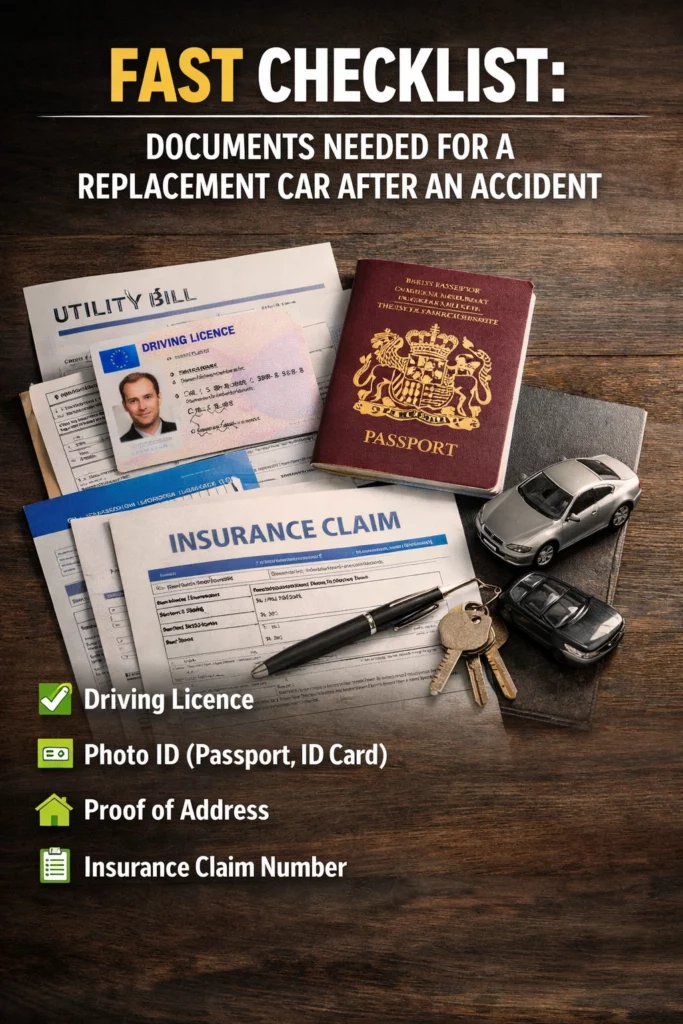
Documents Needed for a Replacement Car After an Accident: Fast Checklist
Replacement car approval after an accident moves faster when you prepare identity, address, and claim documents before an insurer, repair network, or credit hire company starts verification. A standard pack includes a valid driving licence, a second photo ID, proof of address dated within 3 months, and an insurance claim reference number, plus accident details and vehicle ownership evidence.
Contents
- What is the “fast approval” checklist for a replacement car after an accident?
- Which documents prove a genuine need for a replacement vehicle?
- How does a new licence, penalty points, or an international licence change approval?
- What insurance questions do claim handlers ask before approving a replacement car?
- What delays replacement car approval, and how do you prevent delays?
What is the “fast approval” checklist for a replacement car after an accident?
Fast approval uses 4 core documents: a valid driving licence, a photo ID, proof of address, and an insurance claim reference number or policy number. The core documents let a replacement vehicle provider complete identity checks, delivery verification, and insurance validation quickly. A complete pack also includes accident details and vehicle registration evidence for a like-for-like replacement vehicle.
Fast approval checklist documents are:
- Driving licence (photocard, plus paper counterpart where a provider requests a counterpart)
- Photographic ID (passport, national identity card, or work ID for commercial claims)
- Proof of address (utility bill, bank statement, credit card statement, council tax bill, tenancy agreement, or mortgage statement dated within the last 3 months, used for Know Your Customer (KYC) identity checks)
- Claim reference details (insurance claim reference number, policy schedule, or booking reference)
Rental providers also publish proof-of-address rules, and one UK rental provider states that UK residents bring 2 proofs of address dated within the last 3 months for hire collection.
Supporting documents strengthen replacement vehicle eligibility:
- Insurance certificate or policy schedule
- V5C logbook (vehicle registration document) or lease agreement
- Accident details pack (date, time, location, and a short incident description)
- Evidence pack (photos, dashcam footage, witness details, and police incident reference number where a police report exists)
- Credit hire agreement form (credit hire agreement or CHA) and signed terms and conditions when credit hire applies
Which documents prove a genuine need for a replacement vehicle?
Proof of need documents show daily travel reliance and support “reasonable and necessary” replacement vehicle use during repairs or a total loss settlement process. A credit hire company and an at-fault insurer review proof of need and match a like-for-like replacement vehicle to actual usage. Proof of need usually relates to work travel, childcare transport, or medical appointments.
Proof of need evidence examples are:
- Work evidence (shift rota, work schedule, mileage log, client visit diary, or delivery route record)
- Childcare evidence (school run timetable, nursery drop-off letter, or childcare appointment confirmation)
- Medical evidence (hospital appointment letter, clinic schedule, physiotherapy booking, or mobility support letter)
- Commercial driving evidence (private hire licence badge, taxi badge, plating documents, or operator shift record)
Travel cost evidence supports necessity when a provider requests comparison:
- Public transport receipts
- Taxi receipts
- Ride-share invoices
How does a new licence, penalty points, or an international licence change approval?
Licence status changes verification steps, so a provider asks for extra checks when a driving licence is new, carries penalty points, or comes from another country. UK hire providers use the DVLA check code to validate the driving record, and the check code remains valid for 21 days. International licence checks also use translations or an International Driving Permit.
Extra licence verification documents include:
- DVLA check code (driving record sharing code)
- Driving record summary (penalty points, disqualifications, and licence categories)
- International Driving Permit (IDP) or official translation for non‑Roman alphabet licences
- Secondary photo ID when a licence lacks a photo card
Provider rules also use minimum licence holding periods and eligibility checks:
- One UK rental provider lists a minimum 1‑year holding period for UK rentals and uses driving conviction limits for approval.
- One UK rental provider lists licence holding and age rules, and the same provider requests a DVLA check code for England, Scotland, and Wales licence checks.
What insurance questions do claim handlers ask before approving a replacement car?
Insurance questions focus on liability, policy cover, and hire risk, because an insurer and a credit hire company recover hire charges from an at-fault insurer only when eligibility checks pass. A claim handler confirms accident facts, confirms replacement cover on a policy schedule, and confirms driver details before vehicle delivery. A complete answer set speeds replacement car approval.
Insurance questions you expect during approval are:
- Confirm liability status (non-fault driver, at-fault driver, or split liability)
- Confirm cover route (courtesy car through approved repairer, hire car add‑on, third‑party insurer intervention vehicle meaning a direct replacement offer, or credit hire car)
- Confirm claim reference number (claim reference, policy number, and insurer contact point)
- Confirm intervention letter status (offer letter from an at-fault insurer and response record)
- Confirm vehicle status (repairable vehicle, engineer inspection date, or total loss decision)
- Confirm driver eligibility (licence category, penalty points, disqualifications, and age band)
- Confirm named driver list (main driver and additional driver details)
- Confirm use profile (commuting miles, business mileage, school runs, and medical travel)
- Confirm replacement match (like-for-like replacement vehicle, vehicle type, and vehicle category)
- Confirm financial checks (credit card details for deposits in standard rentals, or bank statements for impecuniosity evidence that shows limited funds for upfront hire payments)
What delays replacement car approval, and how do you prevent delays?
Approval delays usually come from incomplete identity checks, outdated proof of address, unclear document images, and inconsistent names or addresses across a driving licence, policy schedule, and V5C logbook. A credit hire agreement also delays approval when signatures or dates remain missing. You prevent delays by preparing clear scans, using recent proof of address, and replying quickly to evidence requests.
Approval moves faster when you complete the following steps:
- Provide clear photos or scans (full document, readable text, and visible expiry dates)
- Match personal details (name spelling and address format across all documents)
- Use current proof of address (documents dated within the last 3 months)
- Share DVLA check code early (driving record validation before vehicle handover)
- Sign credit hire agreement forms promptly (dated signature on CHA, mitigation statement of truth about replacement vehicle need and cost control, and cancellation terms such as a 14‑day cancellation period stated in some agreements)
- Organise accident evidence (photos, repair estimate, and police incident reference number)
- Maintain response timing (same‑day replies to insurer and credit hire company questions)
Can I get a replacement car without comprehensive insurance?
Yes. Replacement car access uses several routes that sit outside comprehensive cover, including a third‑party insurer replacement vehicle offer after liability acceptance and a credit hire car for a non‑fault driver who signs a credit hire agreement. A separate hire car add‑on also supplies a replacement car through a policy schedule when an add‑on exists.
Replacement car routes without comprehensive cover include:
- Third‑party insurer intervention vehicle or replacement vehicle offer
- Credit hire car arrangement for a non‑fault driver
- Self-funded rental with standard rental requirements
What if I can’t prove I “need” a car?
Proof of need drives credit hire approval, because an at‑fault insurer challenges hire necessity when documentation stays thin. You strengthen proof of need with work schedules, school run confirmations, and medical appointment letters, plus travel cost evidence such as taxi receipts. A courtesy car via an approved repairer also supports mobility when a policy includes courtesy car cover.
Can a named driver use the replacement car?
Named driver use requires disclosure and registration, because a provider insures named drivers and additional drivers through terms and conditions. One UK rental provider states that the main driver and any additional drivers attend the counter to show a driving licence, and a credit hire agreement lists authorised drivers. You speed approval by collecting driver licences before handover.
Can I upgrade the vehicle?
Vehicle upgrades depend on replacement route and cost recovery rules. Credit hire companies target a like-for-like replacement vehicle, so an upgrade increases the daily hire rate and attracts scrutiny from an at-fault insurer during hire charge recovery. Rental upgrades also increase deposits and excess, so a provider confirms upgrade terms inside a signed agreement before delivery.