
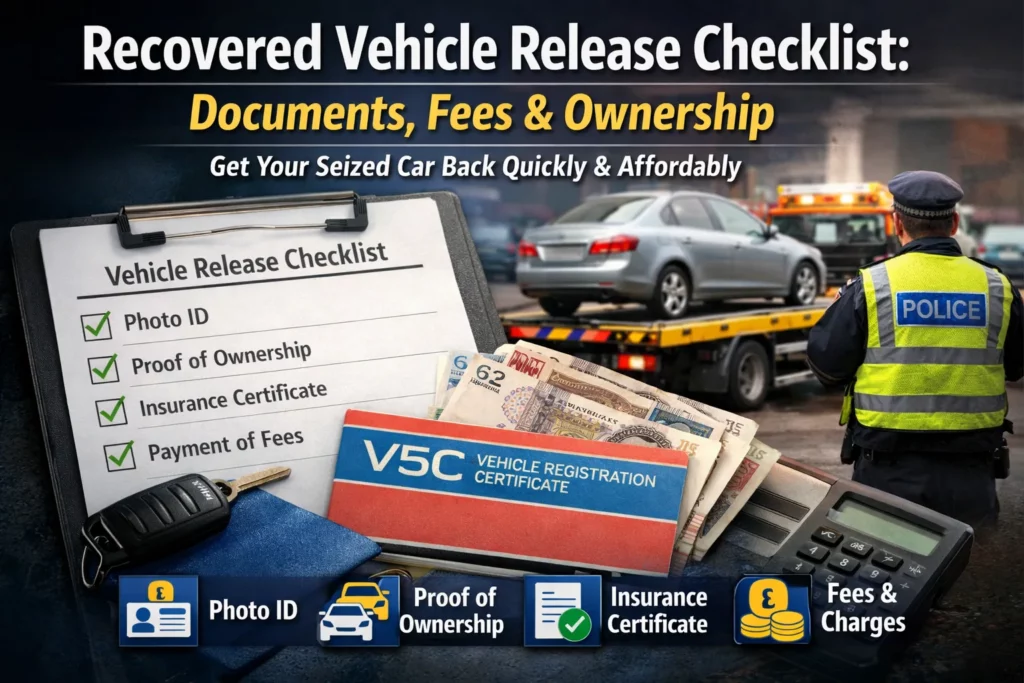
To release a recovered vehicle from a police pound or recovery garage, you usually bring photo ID, proof you’re entitled to the vehicle, and if you plan to drive away a valid insurance certificate and MOT evidence. Charges often include a statutory removal/release fee plus a daily storage charge, so arriving with the right documents helps limit delays and costs.
Contents
- The documents you typically need: proof of identity, proof of ownership, and an insurance certificate
- If you don’t have the V5C log book: registered keeper vs legal owner
- Authority letter / letter of authorisation: when you need it (third-party collection)
- Fees and payments: release/removal fee, daily storage, plus possible admin/DVLA costs
- Reducing common delays that increase storage charges
- When the vehicle is undriveable: PG9 prohibition notice, no MOT, or recovery transport
The documents you typically need: proof of identity, proof of ownership, and an insurance certificate
Most release processes focus on three checks: who you are, your entitlement to the vehicle, and whether the vehicle leaves legally/safely. Requirements vary by police force, local authority, and recovery operator, so your notice letter / seizure notice acts as the primary checklist.
Documents commonly requested include:
- Proof of identity (valid photo ID): passport, driving licence, EU/EEA ID card, immigration document (examples vary by force).
- Proof of ownership / entitlement (examples that different pounds accept):
- V5C log book (full/current), or
- V5C/10 plus a verifiable bill of sale (some forces), or
- Lease/hire agreement (common for leased vehicles).
- V5C log book (full/current), or
- Valid certificate of motor insurance (often required before release, and some forces apply this even if you plan recovery transport).
- MOT evidence (if the vehicle is driven away): a valid MOT, or evidence of a pre-booked MOT appointment (rules vary).
- Proof of address may be requested to match keeper details (common in some pounds).
- Practical items that help the handover run smoothly: keys and (if needed) replacement number plates.
If you don’t have the V5C log book: registered keeper vs legal owner
A V5 (V5C) shows the registered keeper—the person responsible for keeping/using the vehicle—yet it is not proof of ownership. That’s why release teams often accept a mix of documents that demonstrate entitlement (purchase paperwork, agreements, letters).
If your V5C is missing, common routes include:
- Use the alternative options your pound accepts (examples: V5C/10 + bill of sale, or lease/hire agreement).
- Apply for a replacement V5C via GOV.UK (fees can apply in some situations).
- Expect local variation: some pounds accept a V5C/2 as part of a “new keeper” proof set, while others may not accept it as ownership evidence.
If you’re the keeper but not the owner (common scenarios):
- Company car / lease / hire / finance: bring the agreement paperwork and, where needed, written confirmation that you’re authorised to collect. Lease/hire documentation is explicitly accepted in some local authority processes.
If you cannot attend in person, many forces allow a third party (friend/family member) to collect the vehicle, provided they bring additional paperwork.
Common “authorisation letter” pack includes:
- An authority letter signed by you authorising collection
- A copy of your passport or driving licence to help verify the signature
- The collector’s photo ID
- A valid insurance certificate (requirements can be strict when the vehicle leaves the pound).
What to include in the letter (so it processes quickly):
- Vehicle registration (VRM), make/model (if known), and reference/notice number
- Your full name + address, and the collector’s full name + address
- Date, signature, and a contact number
Fees and payments: release/removal fee, daily storage, plus possible admin/DVLA costs
For many police removals, charges are statutory (set nationally) and depend on factors like vehicle size/condition and whether it is on-road/off-road.
Common statutory examples (standard car ≤ 3.5 tonnes MAM):
| Charge type | Typical statutory amount (example) |
| Removal / release (upright, on-road, not substantially damaged) | £192 |
| Storage (per 24 hours or part thereof) | £26 |
| Disposal (if not recovered) | £96 |
Other costs that sometimes appear (situation-dependent):
- DVLA-related steps for untaxed vehicles, including a V62 process fee and possible surety or fines, depending on the case.
- Local authority removals can have their own payment and appeal flow (often: pay first, then receive appeal information).
Reducing common delays that increase storage charges
Storage costs can rise quickly because many systems apply a daily charge and set a specific start point. Some forces state storage starts from midday the day after seizure (or the next working day), so fast preparation supports a lower total bill.
Steps that usually prevent repeat trips:
- Use the notice letter / seizure notice as your “must-bring” list and follow its timeframe.
- Bring accepted proof of ownership for your situation (keeper, new keeper, lease/hire).
- Confirm your insurance certificate explicitly allows release by a government authority (some pounds require this wording/coverage).
- If you plan to drive away, bring MOT evidence or a pre-booked MOT appointment confirmation (where allowed).
- Check opening hours and payment methods before you travel (some locations publish accepted cards/cash rules).
When the vehicle is undriveable: PG9 prohibition notice, no MOT, or recovery transport
If the vehicle is not roadworthy, will not start, or has a PG9 prohibition notice, many forces require collection by a trained, equipped, and insured recovery operator.
Practical options that keep release smooth:
- Arrange a recovery truck / trailer pickup and share the depot’s requirements with the recovery company.
- If the issue is MOT-related, some processes allow driving only with evidence of a pre-booked MOT appointment, otherwise recovery transport fits.
- If the vehicle is recovered after theft, a garage safety check is commonly recommended by police guidance before normal driving resumes.
Do I need insurance to release my car?
Many pounds require a valid insurance certificate that permits release of a vehicle impounded by a government authority, and some state this applies even if you do not plan to drive on a public road. Requirements vary, so your notice letter confirms the exact rule in your case.
Can a friend/family member release it for me?
Often yes, using an authority letter plus a copy of your ID for signature verification, alongside the collector’s own ID and (commonly) valid insurance documentation. Some forces also set conditions for when third-party collection is permitted.
Can I refuse to pay storage fees?
Where statutory charges apply, payment is typically part of the release process. Some authorities explain that you pay on recovery and then receive information about appeal rights or complaint routes. Your notice letter (and the removing authority) sets the applicable method.
What if the car is on finance?
Finance and lease arrangements often mean the registered keeper and legal owner differ, so pounds commonly look for documents that show entitlement (for example, the agreement paperwork and any written authority needed). A V5C supports keeper status, yet ownership is evidenced through purchase/contract documents.