
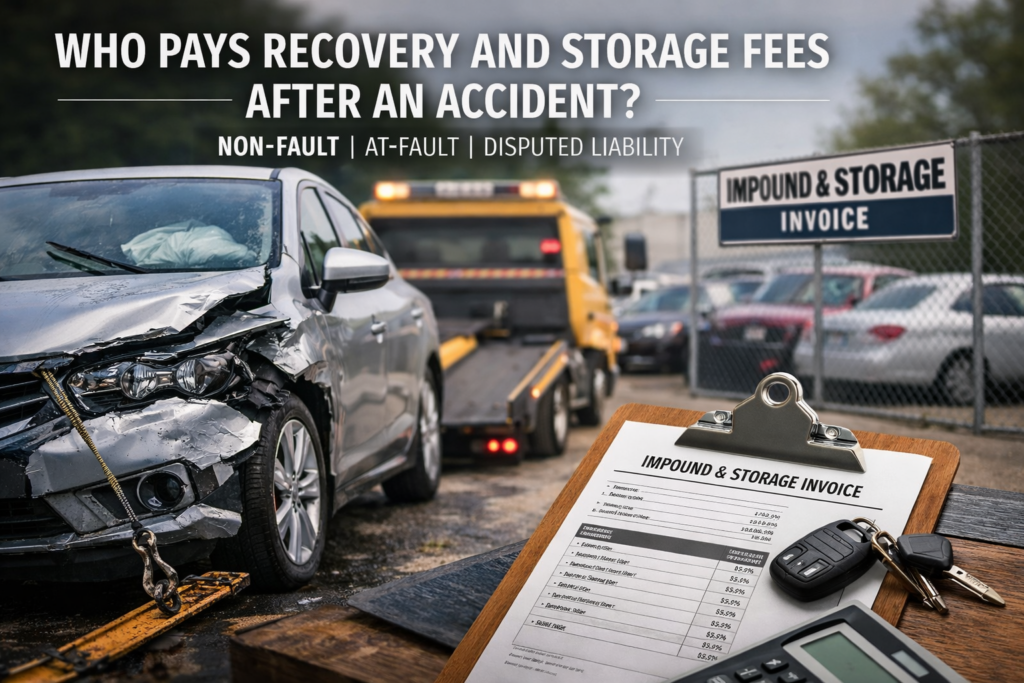
Recovery (towing) and storage charges attach to who pays the property-damage claim and what your policy covers. In fault-based insurance systems, the at-fault driver’s insurer generally handles reasonable towing and storage fees once liability is accepted, while at-fault drivers often rely on their own coverage or pay directly.
Contents
- Who pays recovery and storage fees in non-fault, at-fault, and disputed-fault claims?
- What are typical accident scenarios for towing, impound, and storage charges and who covers what?
- What evidence supports recovery and storage costs in a claim?
- How do insurers decide whether towing and storage charges are “reasonable costs”?
- What do you do when liability is disputed and storage fees keep running?
- How do you minimise recovery and storage costs while the claim is ongoing?
Who pays recovery and storage fees in non-fault, at-fault, and disputed-fault claims?
Recovery and storage fees follow liability and policy coverage. In a non-fault claim, the at-fault driver’s insurer typically reimburses reasonable towing and storage fees as part of the property-damage claim after liability is accepted. In an at-fault claim, payment usually comes from your own collision/roadside cover or you. When fault is disputed, cost control and documentation drive reimbursement.
Quick answer summary (common fault-based handling):
- Non-fault (liability accepted): At-fault insurer reimburses reasonable recovery/towing + storage within the claim.
- At-fault: Your own collision/optional cover pays, or you pay the tow yard and storage facility directly.
- Disputed fault (liability not accepted yet): You often pay up front (or use your own cover) and then seek reimbursement once liability is decided.
What are typical accident scenarios for towing, impound, and storage charges and who covers what?
Typical scenarios link fees to who arranged the tow and where the vehicle sits. A roadside tow to a repairer or insurer-approved lot often stays within standard claim handling. Police-ordered recovery to an impound lot follows local authority rules and daily tariffs. A total loss adds valuation and salvage steps that affect how long storage remains reimbursable.
Common scenarios you see in claims:
- Roadside recovery after a collision: The paying insurer (your insurer or the at-fault insurer) treats towing/recovery as a property-damage expense once the claim route is confirmed.
- Vehicle held at a tow yard / storage yard: Storage accrues daily until the vehicle is released, moved, repaired, or disposed.
- Police removal to an impound/pound: Charges follow government or authority schedules in many jurisdictions and accrue daily under local rules.
- Total loss (write-off) + salvage: Storage continues while inspection/valuation runs; insurers often limit payment to a “reasonable” period and expect action once settlement steps start.
What evidence supports recovery and storage costs in a claim?
Evidence turns towing and storage fees into a clear, itemised loss. You get the strongest reimbursement position when your file shows who authorised recovery, where the vehicle sits, what the daily rate is, and why the storage period is necessary for inspection, valuation, repairs, or salvage. Insurers and courts look for invoices that match dates, rates, and communications.
Keep 8 evidence items together:
- Tow/recovery receipt (date, time, pickup/drop-off locations)
- Storage invoice with daily rate and start date (itemised)
- Photos of vehicle damage and location signage (lot name/address)
- Claim reference and adjuster contact details
- Written authorisation from insurer to release/move the vehicle (or proof you requested it)
- Call log (date/time + summary of each insurer/tow yard conversation)
- Valuation/repair estimate dates (inspection booked/completed)
- Any storage-credit or recovery agreement you sign (terms, rates, liability)
How do insurers decide whether towing and storage charges are “reasonable costs”?
“Reasonable costs” connect to rate, time, and your actions. Insurers compare the daily storage rate to local market rates, review whether the storage days match necessary claim steps (inspection, valuation, repair logistics, salvage), and check whether the vehicle stays in higher-cost storage after clear instructions to move or settle. Itemised bills and written instructions carry weight.
Insurers often assess reasonableness across 3 checkpoints:
- Rate: Itemised recovery + daily storage + admin fees, compared to local equivalents.
- Period: Days that directly match claim activity (inspection, valuation, repairer booking, salvage).
- Conduct (mitigation): Your dated messages and quick moves that keep storage days controlled.
What do you do when liability is disputed and storage fees keep running?
Disputed liability changes the payment timing, not the importance of action. You protect reimbursement by notifying insurers immediately, confirming where the vehicle sits, requesting written authority to move or release it, and selecting a lower-cost storage option when available. Storage charges build daily, and insurers later review whether the vehicle remains in high-fee storage without a claim-processing reason.
A practical dispute workflow that keeps the file clean:
- Open your claim immediately (your insurer and the other driver’s insurer when you have their details).
- Request written confirmation of: liability status, storage coverage position, and next steps (inspect / move / salvage).
- Move the vehicle to controlled storage (insurer-approved lot, repairer, or another secure site) once authorisation is clear.
- Document every date (notification date, inspection date, settlement offer date, release instruction date).
How do you minimise recovery and storage costs while the claim is ongoing?
Cost control focuses on time and location. You reduce storage exposure by locating the vehicle fast, confirming the daily rate in writing, moving it to an insurer-approved or lower-cost facility, and aligning storage time with claim activity such as inspection, valuation, repair booking, or salvage. Insurers evaluate your actions when they review whether charges stay reasonable.
Use a consistent, documented checklist (each action stops extra days):
- Locate the vehicle within 24 hours (tow yard name, address, release rules).
- Request an itemised invoice (recovery fee, daily storage, admin/gate fees).
- Notify the insurer in writing with the storage details and photos.
- Ask for written authorisation to move/release the vehicle.
- Move the vehicle to an insurer-approved lot or repairer as soon as release terms allow.
- Confirm inspection and valuation dates (tie storage days to claim steps).
- Keep receipts and a dated communication log (email/SMS screenshots, call notes).
Can I claim back storage fees?
Storage fees are claimable when they are necessary, itemised, and tied to the property-damage process. In non-fault claims, reimbursement commonly comes through the at-fault insurer after liability acceptance. The file is strongest when it shows prompt notification, clear storage dates, local-rate pricing, and written instructions about moving, settling, or salvaging the vehicle.
Key items that support reimbursement:
- Itemised storage invoice + tow receipt
- Written insurer instructions or authorisations
- Proof the storage period matches inspection/valuation/repair steps
What happens if fault is not agreed yet?
When fault is not agreed, insurers focus on vehicle location, documentation, and cost control while the liability decision develops. You often use your own insurer or pay the facility to release or move the vehicle, then seek reimbursement once liability is resolved. Daily storage continues during investigation, so written updates, authorisation requests, and timely moves strengthen recoverability.
Practical outcomes you commonly see:
- An adjuster schedules inspection/valuation before approving payment.
- Storage reimbursement gets reviewed after liability acceptance and “reasonable cost” checks.
Can storage fees be reduced?
Storage fees reduce when the vehicle moves from high-cost storage to a controlled, lower-cost location and when storage days match claim activity instead of idle time. Tow yards often charge daily plus admin/gate fees, so every day saved lowers the invoice. Insurers also value itemised billing and written proof of your requests to move or release the vehicle.
Common reduction levers:
- Move to an insurer-approved lot or repairer.
- Request itemised billing and rate confirmation in writing.
- Tie storage days to inspection/valuation dates.
What if the other driver is uninsured?
An uninsured driver shifts recovery and storage costs toward your own coverage and any uninsured motorist (UM) options in your policy. You still document the same evidence: tow receipt, itemised storage invoice, vehicle location, and written communications. Insurers handle payment based on your coverage terms, and any later recovery action relies on the same proof of reasonable, necessary charges.
Helpful documentation remains the same:
- Tow and storage receipts + photos
- A dated communication trail with your insurer and the storage facility